
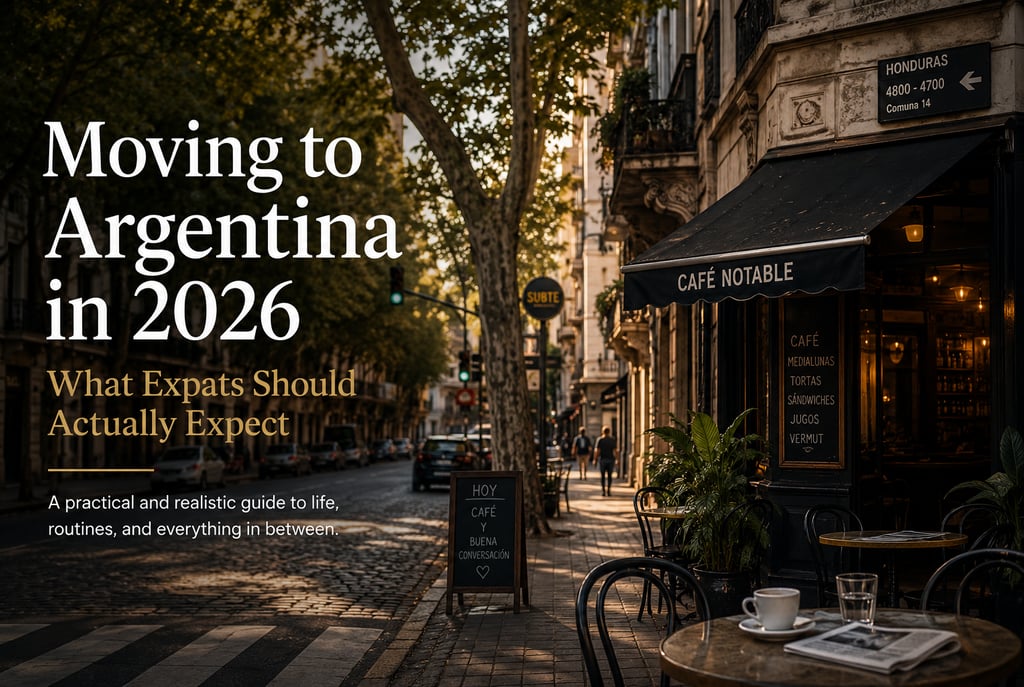
Moving to Argentina in 2026: What Expats Should Actually Expect
A practical and realistic guide to moving to Argentina in 2026, including residency, healthcare, housing, money, culture, neighborhoods, and what daily life actually feels like for expats.
DIGITAL NOMADSEXPATSRELOCATION
Gabriela Arellano
5/13/20267 min read
You land in Buenos Aires tired, overstimulated, and slightly overconfident about how quickly you are going to “figure everything out.”
Somewhere between Ezeiza and the city, the adjustment begins quietly. A taxi driver is explaining politics with complete conviction. Someone is walking four dogs while drinking coffee. Your phone signal disappears just as you try to message the Airbnb host.
Before arriving, you probably spent a significant amount of time preparing the formal side of the move: visas, apartments, healthcare, banking, paperwork, and how to move money internationally. Those things matter, of course.
But by the time you reach the city, another reality starts becoming obvious. Everyone except you already seems to know where they are going, which café they trust, which pharmacy stays open late, and which bakery is worth crossing the avenue for.
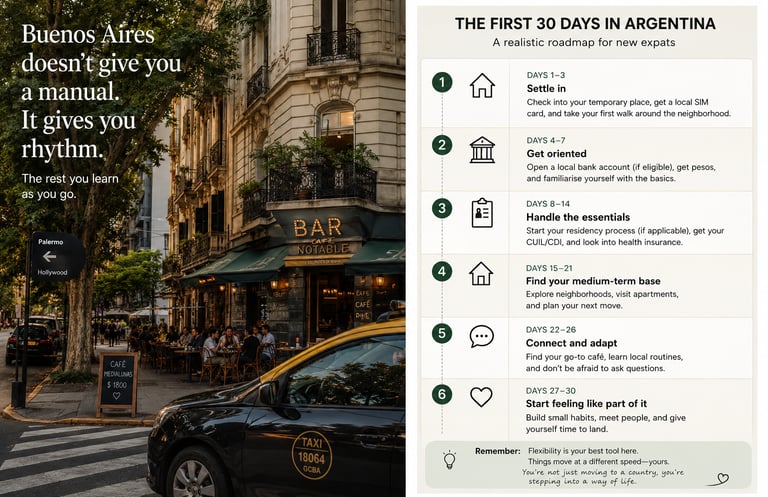
That is the part many foreigners underestimate. Moving to Argentina is not only about organizing the big logistical pieces correctly. It is also about learning smaller operational routines: understanding neighborhoods properly, figuring out transportation, learning how payments work, and gradually recognizing which systems require flexibility and which are surprisingly structured.
And this is probably a good place to challenge one of the most common clichés about Argentina: that life here is simply chaotic.
The reality is more nuanced than that. Yes, daily life here can feel less orderly than in a town of 200,000 people in Norway, but — having lived abroad myself for almost two decades — it will not feel especially chaotic to most people arriving from large cities elsewhere in the world.
Argentina simply requires a different kind of adaptation than many foreigners expect.
This guide explains what moving to Argentina in 2026 actually involves, what tends to surprise foreigners after arrival, and how to avoid some of the more common mistakes during the transition.
Why So Many Expats Are Moving to Argentina
For years, Argentina has attracted a broad mix of foreigners:
remote workers
retirees
entrepreneurs
artists
people looking for reinvention
people escaping burnout
people who initially planned to stay six months and now have very specific opinions about medialunas
Part of the appeal is obvious. Compared to many major U.S. cities, foreigners earning in dollars or euros still often find Argentina relatively affordable. Private healthcare remains accessible by international standards, restaurant culture is strong, and daily life can feel noticeably less transactional than in many North American cities.
But the deeper attraction is harder to explain in spreadsheets.
Many expats are surprised by how socially active daily life still feels here. People spend long afternoons in cafés. Friends sit down for dinner on weeknights without treating it like a logistical operation. Bookstores stay open late.
Conversations are not always efficient. You may notice that Argentinians are not especially optimized for small talk and often open conversations with a looping overture before anybody says anything remotely substantive. Eventually, you stop hearing it altogether — much like the hyper-performed weekend enthusiasm often delivered with the emotional commitment of an airport barista elsewhere in the world.
The city can absolutely be exhausting. But it rarely feels emotionally flat.
The Reality of Moving Here in 2026
Argentina in 2026 is still dealing with inflation, economic adjustment, and changing regulations. Prices move faster than many newcomers initially expect. Certain systems require patience. Immigration and healthcare rules have also become somewhat stricter compared to a few years ago, especially for non-residents relying on outdated online advice.
The relationship Argentinians have with the dollar is also difficult to fully understand at first. After decades of inflation and economic instability, the dollar has become more than a currency exchange reference point. For many people, it functions psychologically as a long-term store of value, a measure of stability, and occasionally something close to a national emotional barometer.
Having lived in Argentina most of my life, I sometimes joke that reading newspaper covers here can feel a bit like Groundhog Day: after a few decades, you begin noticing that many headlines still open with the price of the dollar.
And despite all this, daily life tends to reorganize itself into routines surprisingly quickly. Which is perhaps a more important measure of daily stability than most headlines capture.
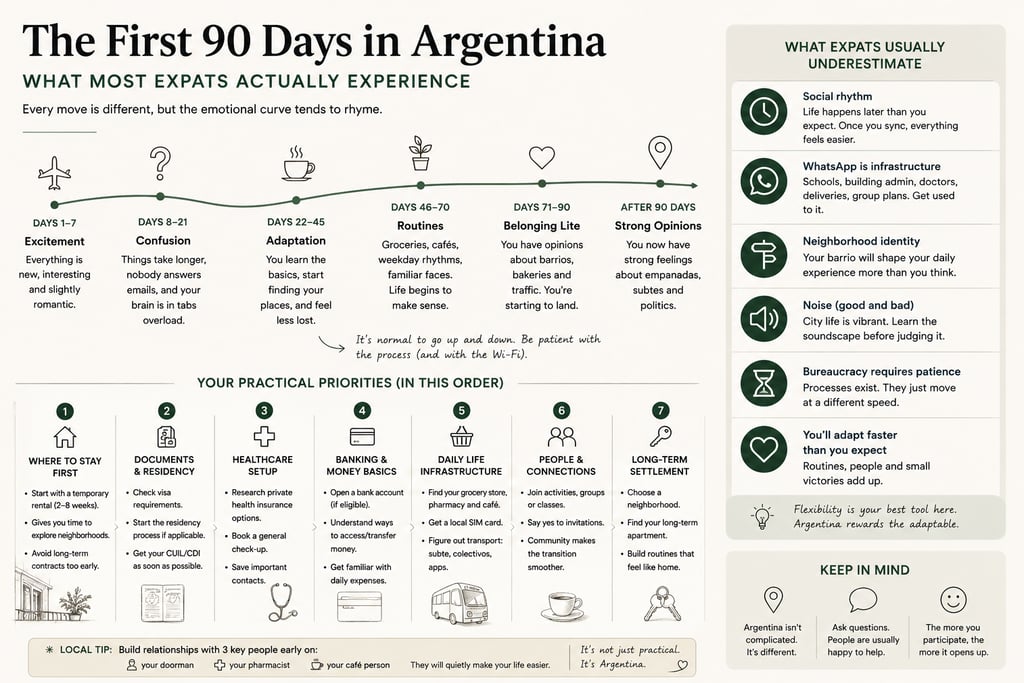
Most expats settle into routines surprisingly quickly:
a preferred grocery store
a trusted pharmacy
a café where the waiter already knows the order
a produce stand they defend with disproportionate emotional commitment
At some point, you stop navigating the city and start participating in it.
That is usually when Argentina becomes easier.
Choosing Where to Live
Most foreigners begin in Palermo, and there are understandable reasons for that.
Palermo is the internationalized version of Buenos Aires: walkable, leafy, full of cafés, restaurants, coworking spaces, gyms, short-term rentals, and enough infrastructure to make the first months abroad feel operationally manageable. It also minimizes friction for newcomers. English is more common there than in many other parts of the city, and daily logistics tend to feel easier to decode.
But Palermo is not the entire Buenos Aires experience.
One of the distinctive things about Buenos Aires is how quickly neighborhoods change personality. Two areas separated by ten blocks can feel socially unrelated.
Recoleta is traditionally the wealthiest and most formal part of the city, full of elegant old buildings, quiet cafés, and apartment blocks that seem to carry themselves with institutional confidence. Belgrano feels more residential and family-oriented: calmer, greener, and slightly less interested in performing urban sophistication for its own sake.
Colegiales often becomes popular later, once people realize they would still like proximity to Palermo but would also like to sleep through the night occasionally.
San Telmo attracts romantics for both excellent and operationally questionable reasons. It occupies a similar emotional space to places like Venice: beautiful, historical, atmospheric, and not always fully aligned with practical living.
Microcentro can feel overwhelming at first: beautiful old buildings, heavy pedestrian traffic, endless movement, and a kind of weekday intensity that seems permanently five minutes away from either a political demonstration or a lunch break.
And almost every expat eventually becomes unexpectedly invested in neighborhood discourse. People arrive planning to “stay flexible” and end up debating tree cover, water pressure, and whether local coffee qualifies as “umbrella juice” inside Facebook groups with increasingly hyperlocal names.
Renting an Apartment
The rental market in Argentina has changed significantly over the past several years.
Long-term rentals can still be difficult for foreigners without local guarantees, Argentine income, residency documentation, or local references. At one point, this even produced a small classifieds ecosystem offering rental guarantees of somewhat flexible legal seriousness, although that market seems far less visible today. Because of that, many expats begin with temporary furnished rentals before transitioning later into local contracts.
The challenge is not usually finding apartments. The challenge is learning how to evaluate them properly.
Noise matters more than many newcomers expect. Water pressure matters more than anyone initially believes. Air conditioning placement can become surprisingly important by January.
And Buenos Aires apartments occasionally contain combinations that feel almost architecturally philosophical:
beautiful French doors
twelve-foot ceilings
incredible natural light
and a shower operating under terms known only to itself
You start asking different questions after the first month.
Healthcare in Argentina
One of Argentina’s strongest advantages remains healthcare, especially within the private system.
Buenos Aires has excellent doctors, respected hospitals, and private insurance plans that still feel remarkably affordable to many foreigners arriving from the United States.
Most long-term expats eventually use providers such as:
OSDE
Swiss Medical
Hospital Italiano
Galeno
Public healthcare still exists, and emergency care remains broadly accessible, but recent immigration changes have made the situation more complex for non-residents than many older expat guides suggest.
Having worked as a lawyer in Argentina before living abroad myself, I have seen how quickly regulations and everyday procedures here can change.
As a result, I strongly recommend avoiding healthcare or residency advice taken exclusively from outdated forums or old Facebook threads. Argentina changes. Regulations evolve. The practical reality is often more current than the internet.
The good news is that private healthcare in Buenos Aires is often genuinely very good.
The slightly funny news is that, eventually, many foreigners are also surprised by how much medical coordination in Argentina eventually happens through WhatsApp.
Money, Inflation, and Daily Life
This is usually the subject newcomers obsess over before arriving and gradually normalize afterward.
Yes, inflation affects daily life.
Yes, prices change frequently.
Yes, Argentines discuss the economy constantly.
However, inflation is significantly lower than it was only a few years ago. In 2023, annual inflation surpassed 200%. By 2025, it had fallen to around 31.5%, according to Argentina’s official statistics agency (INDEC), although prices still tend to move faster than most foreigners are accustomed to.
But even during the worst inflationary periods, daily life retained a surprising degree of continuity. Restaurants remained full. Birthdays still became multi-hour events. Somebody was always bringing pastries into an office somewhere. Daily routines adapt faster than many outsiders expect.
Foreigners sometimes imagine economic instability as something visually catastrophic. In practice, daily life in Buenos Aires often feels much more functional than they anticipated, particularly in wealthier neighborhoods.
The larger adjustment is usually psychological.
You stop thinking in fixed numbers.
You become more flexible with planning.
And eventually, without fully noticing when it happened, conversations about exchange rates stop sounding like advanced mathematics.
Should You Move to Argentina?
Not all expatriations are made the same. Much like a long-term divorce, the experience depends partly on how emotionally resolved you are about the place you are leaving behind, and partly on how realistically familiar you are with the one you are moving into.
I cannot help you much with the level of closure you have regarding your country of origin. But I can help you develop a more realistic sense of what you are likely to find in Argentina.
Buenos Aires, in particular, tends to work better for people who feel comfortable inside slightly unstructured environments.
This is not a city obsessed with optimization, procedural rigidity, or closely policing how other people live. Street lights are occasionally interpreted more as suggestions than commands. Entire social plans can materialize two hours before they happen. Friends still call spontaneously at night to meet for dinner or drinks without treating it like a calendar negotiation exercise.
Many expats end up loving the degree of everyday freedom this creates. Social norms feel comparatively forgiving. People dress casually. There is generally less pressure to constantly optimize your life or perform efficiency at all times.
For some foreigners, this becomes exhausting. For others, it becomes the only type of life they can imagine living from then onwards.
Explore more posts in our Expats category
Know Argentina
Discover diverse insights about Argentina's rich culture.
Connect
stay in the loop
info@knowargentina.com
© 2025. All rights reserved.