
Argentina's Ethnic Composition: Why Is It So Controversial?
Argentina’s ethnic composition is often reduced to competing myths. This article examines the demographic math behind the debate, including Indigenous and African ancestry, interracial marriage, mass European immigration, genetics, and the difference between ancestry, appearance, and identity.
CUSTOMSPERIODO COLONIALHISTORYCOLONIAL ERAPEOPLE
Gabriela Arellano
5/13/20267 min read
Few questions about Argentina generate as much disagreement as a seemingly straightforward one:
What is the ethnic composition of Argentines?
For many people, the answer appears obvious. Argentina is portrayed as the "European country of Latin America," shaped primarily by Italian and Spanish immigration. Others argue that this image is largely a myth, one that erased the country's Indigenous and African roots through political ideology and selective historical memory.
Both perspectives contain elements of truth. Neither, on its own, adequately explains the country that exists today.
The problem is not simply a lack of information. It is that the discussion often combines facts that belong to completely different categories. Ancestry is confused with appearance. Appearance is confused with identity. Colonial census categories are compared with modern genetic studies. Percentages are quoted without considering the size of the populations behind them. Buenos Aires is treated as though it represented the whole country. Three centuries of demographic change are compressed into a single narrative.
When those distinctions disappear, so does historical clarity.
This article is not an attempt to defend a national myth or replace it with another. Instead, it asks a simpler question:
Why is Argentina's ethnic composition so difficult to understand?
The answer lies less in ideology than in demography.
Argentina Was Never Empty—but It Was Sparsely Populated
One of the most persistent misconceptions about Argentina's history is that the country was either "empty" before European immigration or, conversely, that it resembled the densely populated civilizations of central Mexico or the Andes.
Neither description is accurate.
Long before Spanish colonization, the territory that would become Argentina was home to numerous Indigenous peoples with distinct languages, economies, political structures, and ways of life.
The Diaguita peoples developed sophisticated agricultural societies in the Northwest. Guaraní communities occupied much of the Northeast. The Chaco was inhabited by peoples such as the Qom, Wichí, and Mocoví. The Pampas and Patagonia were home to Tehuelche, Ranquel, Mapuche, Selk'nam, Yagán, Huarpe, Comechingón and many others.
The territory was therefore anything but empty. Yet its total population was extremely small compared with the great population centers of Spanish America.
Historical estimates place the population of the territory that became Argentina at roughly half a million people around 1800, compared with approximately five to six million in Mexico and about 1.3 million in Peru. Argentina was also substantially larger than either country. Its defining demographic characteristic was not the absence of Indigenous peoples, but the presence of a relatively small and widely dispersed population across an enormous territory.
That distinction matters enormously.
The Valley of Mexico and the central Andes supported large urban civilizations, intensive agriculture, and populations measured in the millions before European contact. The territory that became Argentina did not. This difference would later shape everything that followed.
Demography Is Destiny
Population history is not only about percentages.
It is about denominators.
Consider Argentina's first national census.
In 1869, the country counted approximately 1.88 million inhabitants. That same territory covered nearly 2.8 million square kilometers.
For comparison, Mexico's population during roughly the same historical period exceeded ten million people. Peru's population was also substantially larger relative to its territory.
Argentina was an immense country with a surprisingly small population. This seemingly simple fact explains much of what happened afterward.
Suppose two countries each receive one million immigrants.
If one country already has twenty million inhabitants, the newcomers certainly matter—but they do not fundamentally transform the country's demographic profile.
If another country begins with fewer than two million inhabitants, one million newcomers represent an extraordinary demographic force. The mathematics are entirely different.
This is precisely what happened in Argentina.
The Immigration That Changed a Country
Between the late nineteenth century and the First World War, Argentina experienced one of the largest immigration waves in modern history.
Millions of newcomers arrived, especially from Italy and Spain, but also from France, Germany, Switzerland, Britain, Eastern Europe, the Ottoman Empire and many other regions.
By 1914, approximately one-third of Argentina's population had been born abroad.
These were not marginal numbers. The country's population grew from approximately:
1.88 million (1869)
4.04 million (1895)
7.9 million (1914)
In less than fifty years, Argentina's population more than quadrupled. This demographic explosion cannot be explained by ideology alone. It happened because millions of people actually arrived.
The importance of European immigration is therefore not merely a national myth. It is also demographic reality.
The Numbers Behind the Afro-Argentine Debate
Few historical questions illustrate the importance of demographic arithmetic better than the history of Afro-Argentines.
Many readers have encountered the claim that approximately 30% of colonial Buenos Aires was Black or Afro-descended.
Whether the exact figure should be 25%, 30%, or somewhat higher depending on the census categories employed is less important than understanding what the statistic actually means.
Thirty percent of what population? Colonial Buenos Aires was not a city of millions. It was a city measured in tens of thousands.
This does not diminish the importance of Afro-descended communities. Quite the opposite. They were essential participants in the economic, military, religious and cultural life of colonial Argentina. But percentages require denominators.
Thirty percent of a relatively small colonial city is historically significant without implying that Argentina ever possessed an Afro-descended population comparable in size to Brazil or the Caribbean.
The distinction is mathematical, not ideological.
What Happened to Argentina's Black Population?
Popular explanations usually emphasize one cause. Some point to war. Others point to yellow fever. Others emphasize deliberate erasure by the Argentine elite.
Each explanation contains part of the story. None explains the whole picture.
The historical evidence suggests that several processes occurred simultaneously.
Afro-Argentine men participated disproportionately in wars of independence, civil conflicts and later military campaigns. Yellow fever affected poor neighborhoods with particular severity. Political elites increasingly promoted a European image of the nation.
But another process was equally important.
Intermarriage.
Over generations, many Afro-descended Argentines became part of broader mixed families. Their descendants did not disappear. They simply ceased, in many cases, to be socially classified as a separate Black population.
This distinction is fundamental. Ancestry and social identity are not the same thing. A person may possess African ancestry without being socially recognized—or recognizing themselves—as Black. Genes can survive long after categories change.
The Forgotten Importance of Mestizaje
Perhaps the greatest weakness of modern discussions is their tendency to reduce ethnic mixing to a single mechanism. History is rarely that simple. Colonial Latin America undoubtedly witnessed slavery, coercion and sexual violence. To deny that would be historically indefensible.
But reducing every mixed family to coercion is equally unsatisfactory. Argentina possesses unusually rich documentary evidence.
Catholic parish registers preserve baptisms, marriages and burials stretching back centuries. Anyone who spends time exploring these records quickly notices something striking. Interracial marriages appear again and again.
White men married Black women.
Black men married white women.
Mixed families appear across generations.
This observation does not prove that most ethnic mixing occurred through marriage. No surviving source can establish such a proportion. Parish registers exclude informal unions and cannot reveal the private circumstances behind every relationship. Nevertheless, they establish something important...
Interracial marriage was neither imaginary nor extraordinarily rare.
It formed part of ordinary Argentine family history.
Genetics Adds Another Layer
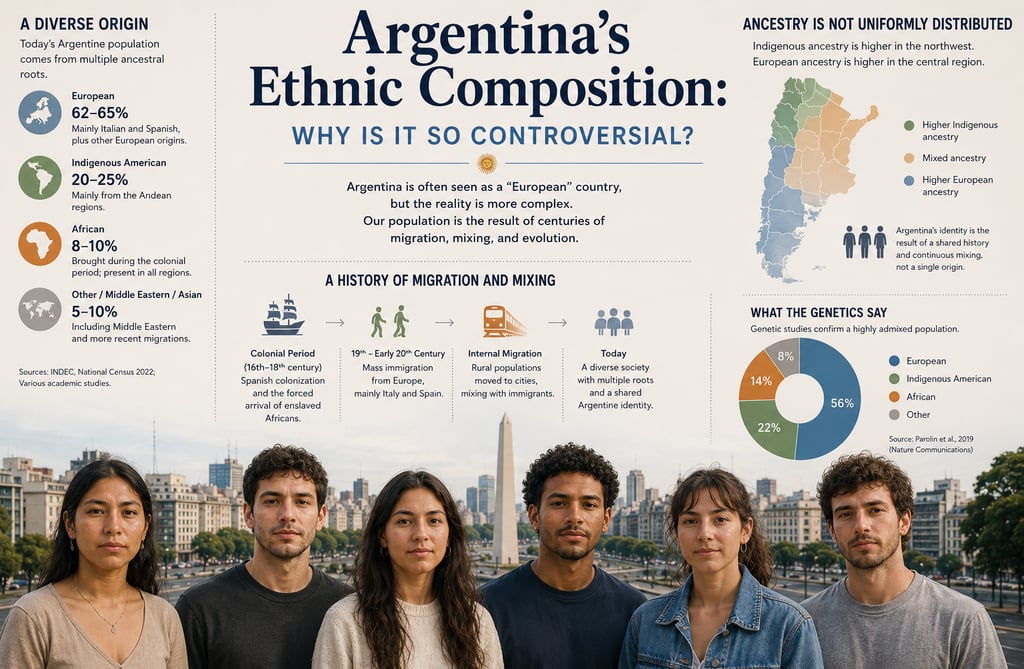
Modern genomic studies tell a complementary story. Research consistently shows that contemporary Argentines possess varying proportions of European, Indigenous and African ancestry.
The proportions differ considerably by region. Northwestern Argentina generally shows stronger Indigenous ancestry. Buenos Aires tends to exhibit a higher European component. African ancestry is typically smaller but remains detectable across many regions. This is precisely what one would expect after centuries of mixture followed by massive immigration.
Genetics therefore confirms something important: Argentina's Indigenous and African ancestry did not disappear. It became incorporated into the broader population.
The challenge is that genetics answers only one question. It tells us that admixture occurred. It does not tell us how each ancestral contribution entered particular families. Genes cannot distinguish between marriage, informal unions, coercion or any other historical circumstance. For that, historians must turn to documentary evidence.
Two Different Archives
While researching this subject, I spent many hours comparing publicly available genetic profiles, published genomic studies and FamilySearch parish records. My work was that of an interested independent researcher, not a professional population geneticist or historical demographer. I therefore make no claim to have produced original statistical research.
Nevertheless, I came away with a strong impression. These two worlds seem to be describing the same historical reality from different perspectives. Genetics demonstrates that modern Argentines are far more mixed than older national narratives often suggested.
Parish records document countless legally recognized families formed across the racial categories of their time. Neither source alone solves the puzzle. Together, however, they suggest that the evidence needed to understand Argentina's demographic history may already exist.
The challenge is computational rather than documentary. Millions of genealogical records remain scattered across archives. Millions of genetic profiles exist in academic studies and consumer DNA databases. Connecting those two worlds would require a level of interdisciplinary collaboration far beyond the resources of an individual researcher.
Historians, geneticists, genealogists and data scientists each possess pieces of the puzzle. Very few projects attempt to assemble them.
The Politics of Memory
None of this means that Argentina's European self-image emerged naturally. Political ideas mattered. Nineteenth-century elites openly admired Europe. Immigration policies encouraged European settlement. Schools, literature and public discourse frequently emphasized European ancestry while paying comparatively little attention to Indigenous and African contributions. That process shaped how generations of Argentines understood themselves.
Yet ideology alone cannot explain the country's demographic transformation.
Millions of immigrants genuinely arrived. Millions of descendants genuinely exist today. The European component of Argentina's population is therefore neither an invention nor the whole story.
Both propositions are true simultaneously.
Why the Debate Persists
The controversy surrounding Argentina's ethnic composition survives because different participants are often answering different questions.
One person asks about genetics. Another thinks about visible appearance. Someone else discusses historical injustice. Another focuses on family genealogy.
Each may be correct within their own framework while appearing to contradict everyone else. Historical understanding requires keeping these categories separate. A person can have Indigenous ancestry without identifying as Indigenous. Someone may descend from Africans while no longer being socially classified as Black. Recent Italian grandparents can coexist with Indigenous ancestors several centuries further back.
These realities are not contradictory.
They are simply the consequence of generations of demographic change.
A History That Resists Simple Narratives
Argentina's ethnic history is neither the story of a purely European nation nor the story of a population whose European identity is entirely fabricated.
It is the story of a vast and relatively underpopulated territory shaped by Indigenous peoples, Spanish colonization, African heritage, centuries of mixture, one of the largest immigration waves in modern history, and political narratives that emphasized some parts of that history more than others.
The evidence suggests that Argentina's Indigenous and African roots were never erased biologically. Neither were they always remembered socially.
Perhaps the most useful conclusion is also the least ideological: Argentina's ethnic composition becomes controversial when we confuse percentages with numbers, ancestry with identity, genetics with history, and politics with demography.
Once those distinctions are restored, much of the apparent contradiction disappears.
The country's history remains complex.
But it also becomes considerably easier to understand.


Explore more posts in our Argentine People & Culture
Know Argentina
Discover diverse insights about Argentina's rich culture.
Connect
stay in the loop
info@knowargentina.com
© 2025. All rights reserved.