
Argentina Ethnicity: National Narratives and Genetic Reality
Discover the truths and myths behind Argentina’s most widespread narratives, uncovering a richer and more complex ethnic history than is commonly believed.
CULTURETRADITIONSPEOPLEHISTORY
Gabriela Arellano
1/6/20263 min read
Argentina has long cultivated an image of itself as a European-looking nation. For over a century, this self-portrait has shaped cultural identity, public imagination, and even schooling. Yet, as in any story shaped by those who speak the loudest, there is more beneath the surface.
As a folk Argentine song reminds us: “If the history is written by the winners, that means that there is another history.” Here, the “winners” are not necessarily malicious—they are the voices that framed national identity, the settlers, and later, urban elites. The other history—hidden, fragmented, and often overlooked—lies in the true ethnic and demographic complexity of the population.
The Bias Manifests in the Lack of Inquiry
The persistence of the “white Argentina” narrative is not necessarily rooted in malice. Many Argentines have genuinely believed this story, even without statistical or historical evidence to support it. Where bias appears is subtler: in the scarce motivation to research the country’s true ethnic composition.
Unlike in parts of Central America or Brazil, there are not abundant comprehensive studies that explore Argentina’s demographic history. Outside a handful of genetic and anthropological analyses, large-scale investigation into the interweaving of Indigenous, European, and African ancestries hasn't been as extensive as you may wish. This deficiency allows folklore and incomplete narratives to persist as if they were fact.
Indigenous Roots: Present, but Invisible
Indigenous peoples—the pueblos originarios—inhabited Argentina long before European arrival. Their communities, however, were historically smaller than in Central America, which partly explains why their presence has been less visible in urban centers and mainstream narratives. Estimates suggest that at the time of the Spanish arrival, the Indigenous population numbered 1,300,000, compared with roughly 11,000,000 in Mexico.
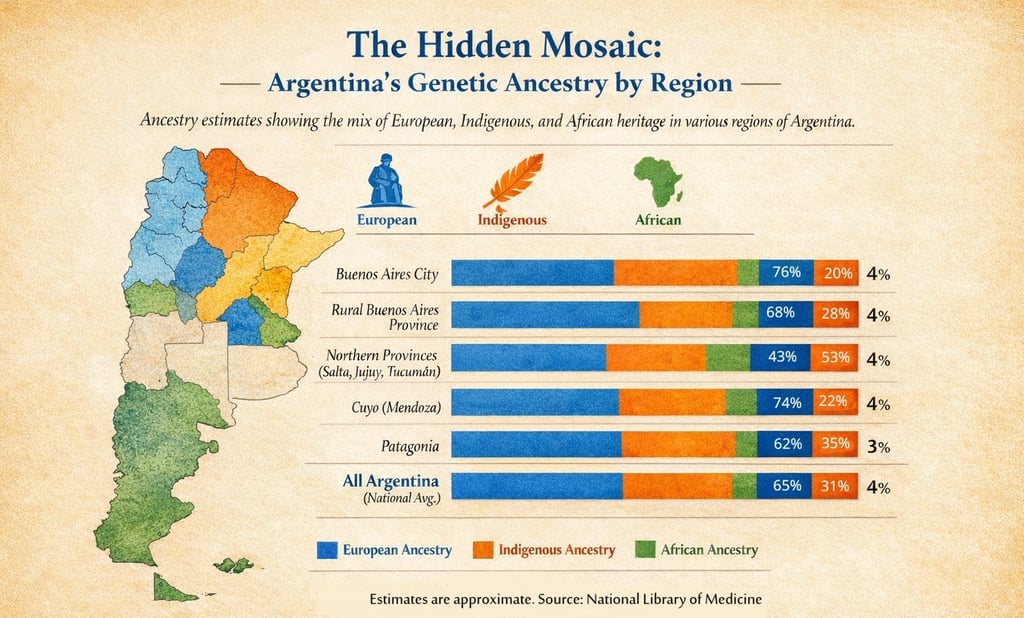
The 2022 census reports roughly 3 % of Argentines self-identify as Indigenous (argentina.gob.ar), yet genetic studies reveal a more complex story: most Argentines carry 18–31 % Indigenous ancestry, with higher percentages in northern provinces and Patagonia (pmc.ncbi.nlm.nih.gov). This ancestry is often invisible in public discourse, school textbooks, and cultural self-perception, yet it quietly shapes the population’s genetic mosaic.
African Ancestry: Small but Significant
Argentina’s African-descended population was much smaller than in Brazil or the United States, largely because the transatlantic slave trade concentrated elsewhere in South America. In late colonial Buenos Aires, enslaved Africans may have comprised 10–30 % of local populations in certain neighborhoods, but their numbers never approached the massive concentrations seen in Brazil or the U.S. South.
Despite this, African Argentines played a visible role in demographic and cultural life. Extensive interracial unions with European and Indigenous peoples occurred, leaving a genetic legacy still detectable today. Modern studies indicate that Argentines carry, on average, 2–4 % African ancestry, with regional variations reflecting centuries of blending (pmc.ncbi.nlm.nih.gov). Yet, like Indigenous roots, African ancestry has often been socially obscured, reinforcing the sense of Argentina as a predominantly European nation.

Interracial Unions: The Hidden Mosaic
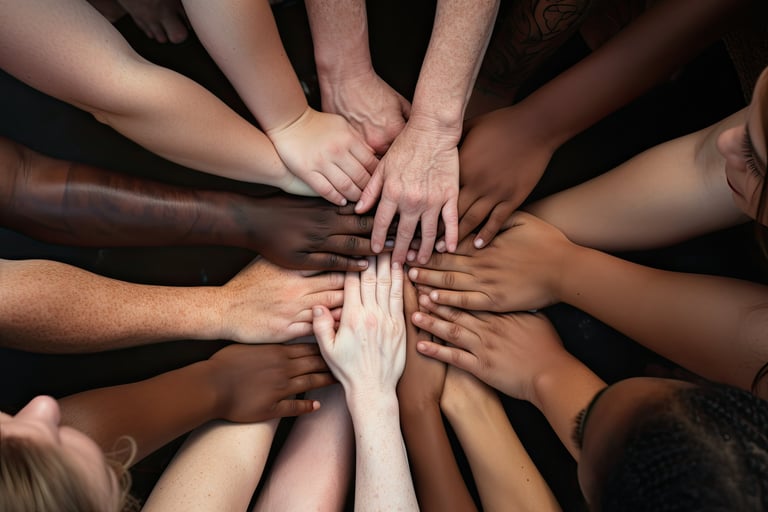
From colonial times to the great waves of European immigration in the 19th and 20th centuries, people of Indigenous, African, and European descent intermarried and had children, creating a rich and complex genetic tapestry. Even in Buenos Aires, considered the epicenter of European influence, most individuals carry some Indigenous or African ancestry, despite identifying as “white.”
These patterns challenge simplified narratives: Argentina was never purely European, even if its elites and national stories suggested otherwise. The mosaic of ancestries has always existed—it was simply less studied, less acknowledged, and often left invisible.
The Role of Research—or Its Absence
What shocks many observers is not deception, but the scarcity of rigorous demographic research. Comprehensive studies tracing Indigenous survival, African presence, and intermarriage are rare compared to other regions of the Americas. Where research exists, it reveals a nuanced, interwoven population. Where it doesn’t, popular narratives filled the gaps, reinforcing the image of Argentina as overwhelmingly European.
Identity, Perception, and the Future
The “white Argentina” narrative is less a conspiracy than a habit of selective memory. It shapes self-perception, educational content, and international imagination. Yet, growing awareness and genetic evidence reveal the true diversity of the Argentine people: Indigenous and African roots interwoven with European ancestry, complex regional variation, and centuries of cultural blending.
Acknowledging this history does not diminish the European influence—it enriches the story, revealing a nation that has always been more diverse and intertwined than the myths suggest. As the folk song warns, the history told by the “winners” is only part of the truth. Uncovering the other histories is not an attack on identity—it is an invitation to understand Argentina in its full, intricate mosaic.
Explore more posts in our Argentine People & Culture
Know Argentina
Discover diverse insights about Argentina's rich culture.
Connect
stay in the loop
info@knowargentina.com
© 2025. All rights reserved.